By: Ben Zimmerman, Haverford ’27; Image from Al Jazeera
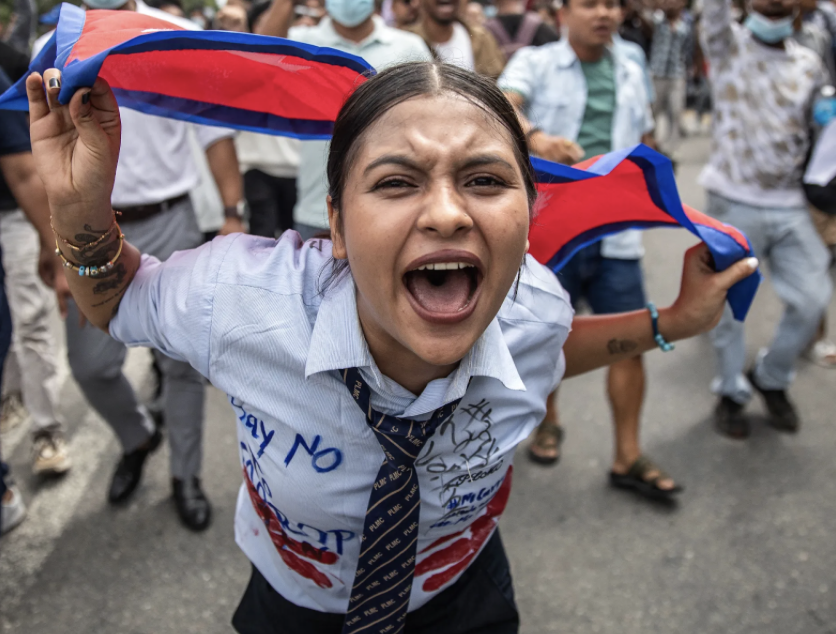
On a Monday in September a group of students gathered in Kathmandu to hold a protest, hoping to express dissatisfaction with their country’s perpetually corrupt and ineffective government. Protests and national strikes are a routine occurrence in Nepal, where the democratic experiment has been slow to progress past infancy. But unlike most protests, this gathering was not organized by or affiliated with any political party; it was students who, via social media, had spread the word of a gathering in which everyone would wear their school uniforms- a show of both unity and youth. Organizers admit they weren’t sure what they’d achieve- if anything. What began as an uneventful demonstration precipitated 48 hours of anarchic chaos and radical political upheaval like the country had not seen since its Civil War two decades prior.
Nepal’s student-led demonstrations are part of a global trend of what are being called “Gen-Z Movements”. Most recently, the Bulgarian government was forced to resign last week after ongoing protests against a proposed budget which would raise taxes on the working class. On November 15th “Generation Z” demonstrators took to the streets of Mexico City disavowing the government’s failure to control ongoing cartel-driven violence and corruption, triggered by the assassination of a Mayor. In early October, “Gen Z Madagascar” played a major role in the ousting of President Andry Rajoelina, the leader of the world’s fifth poorest country where 70% of the population lives without electricity. Around the same time, the small island nation of the Maldives erupted into youth-led demonstrations following the passage of a bill restricting media liberty, just one indicator of democratic backsliding, opposition groups claim.
Although the movements conveniently fall under the same “Gen Z” label, their conditions and impact are far from uniform. Youth participation was varied: in some instances “Gen Z” played a truly meaningful role in organizing change-provoking unrest while other movements co-opted the label in the hopes of raising national support and international awareness. Assessed broadly, these movements do not provide some profound insight about a generation suddenly infatuated with political participation. Rather they serve to reveal new modalities that are available to the political dissidents of psuedo-democracies. Additionally, their aftermath calls into question the long-term effectiveness of movements that band together overnight over social media channels.
In Nepal, the movement began on Instagram. Even in 2025 when the hashtag seems like an artefact of the past, it was the hashtag #NepoKids that prompted individual content creators to begin sharing makeshift exposes on the lavish lifestyle of politicians and their children. Set to the tune of ABBA’s Money, Money, Money the short videos depicted contrasting lifestyles: Louis Vuitton bags and Mykonos vacations flaunted in social media posts versus millions dealing with the daily realities of poverty. The message was simple: money was being stolen from impoverished Nepali citizens to fund the exotic lifestyles of those who run the country. And while not strictly accurate, the sentiment brought a fresh wave of attention to the nepotistic practices engrained in government.
Perhaps unwisely, it was with online dissent already brewing that the government, led by Prime Minister KP Oli, took aim at social media accessibility. Without warning officials imposed a deadline of one week within which all social media companies functioning in the country were required to register with the Nepalese government in order to comply with regulations. By all reasonable measures the requirements and the deadline were arbitrary and hastily drawn up. With a few exceptions, most mainstream platforms, including Facebook, WhatsApp, and Instagram, failed to register and were banned in the country on September 4th. The government cited a Supreme Court directive as its justification and while its exact motives were unclear, at the very least the move revealed blatant negligence of a youthful population reliant on social media for daily commerce and communication.
On September 8th student-led demonstrations were held in Kathmandu and across the country. A group of youth voice social media accounts disseminated communication about the logistics through Facebook and Instagram although it remains unclear who was responsible for organizing the protests. Without another clear identifying feature, the demonstration simply became known as the “Gen Z Movement”. Those at the forefront took it upon themselves to emphasize they were not protesting just a social media ban, but years of corruption and nepotism in government.
What started peacefully quickly turned violent when police began to fire on the demonstrators in the capital, first with tear gas then with live rounds. Photos flooded social media, the ban apparently ineffective, of college students drenched in blood carrying friends who had been shot in the head and neck. As the violence progressed so did the outrage, with each act of police brutality documented and shared by hundreds of attentive phone cameras. At the day’s end 19 people were dead with hundreds more injured.
More emboldened than ever, demonstrators returned to the streets in throngs the next morning, ready to unleash havoc. In a series of separate yet seemingly calculated moves, demonstrators managed to infiltrate and set ablaze the country’s parliament, the houses of key political figures, the government’s administrative building, the Supreme Court, and the country’s largest 5-start hotel, amongst other key landmarks. Even as PM Oli announced his resignation the violence and looting continued. By this point, those serving as the de facto mouthpiece for “Gen Z” disavowed the violence, issuing statements that their movement had been infiltrated by those seeking to cause chaos.
A historically deadly 48 hours came to a close when the army seized control of the nation, imposing nationwide curfews. In the days that followed, the President, still holding his position, held unprecedented impromptu talks with youth who had become known as Gen Z leaders. His message was hopeful and stern: young people who wanted change were seeing change, now it was up to them to figure out how the country moved forward. In what became internationally coined as the “Prime Minister chosen over Discord”, the leaders chosen to represent Gen Z held online forums to discuss who they felt should lead the country. Ultimately, parliament was dissolved and their pick, a former Supreme Court Justice Sushila Karki, was appointed as interim Prime Minister, the first woman to hold the position in Nepal’s history.
In the months that have followed, Karki’s government has been tasked with holding general elections in February. For many, the optimism that followed the September upheaval and her leadership of a new government has died down as the difficult reality of implementing lasting change on a corrupt system has set in. Establishment politicians, the very ones in power when the government was overthrown, have quietly reemerged on the political scene, many announcing their candidacy in the forthcoming elections. There is growing pessimism about whether elections will even be held and if the outcome will introduce new leaders or reinstate the politicians of the past.
Nepal follows a trajectory similar to that of Bangladesh, a nation just 18 months removed from its July Revolution , a youth-driven movement that led to the toppling of autocratic leader Sheikh Hassina. During the nation-wide uprising 1400 protesters were killed, for which Hassina has since been sentenced to death. Like Nepal, the students responsible for the movement took part in installing a leader of their choice, an economist and Nobel Peace Prize winner, Muhammad Yunus.
But frustration is growing for Bangladeshis, as imparting lasting change on the corrupt and ineffective machinery of government takes time. A new student-led party has formed, the NCP, but its leaders are also realizing that protest power does not always translate to electoral success. Faced with rival establishment parties who benefit from resources and networks that the NCP has not yet developed, the student faction lags behind in recent polling. The elections, set for February, will coincide with Nepal’s general election.
The leaders of Nepal and Bangladesh’s unprecedented youth movements are discovering the reality of rooting out corruption and nepotism. Undemocratic practices, like democratic practices, entrench themselves in every part of government. While interim governments are symbolically hopeful, lasting change requires electoral victories. Unfortunately, youth demonstrators worldwide have yet to show the same fervor in showing up to ballot boxes that they showed in taking to the streets. A reality of movement organizing is that voting simply isn’t as sexy as protesting. Additionally, students who march together do not always vote together. Unifying young people in elections requires the establishment of legitimate, resourced political parties, organizations that take decades not months to form. All this goes to say, elections are still on the horizon and perhaps young people will band together in firm rejection of establishment politicians, mobilized through the same social media platforms that got them out to protest. Gen Z movements pride themselves on bringing unprecedented change- perhaps they will do so again.