By Erik Fagerstrom, Haverford College ’27; Image by the US Naval Institute
Since the start of Trump’s second term, newspapers and analysts have noted increased defense spending and a new focus on protectionism worldwide. Particular focus has been paid to China as they continue to modernize and build up its arms. However, China’s military has been changing for longer than many realize. Many of China’s military modernizations and changes began before Trump and are only now being recognized. These changes, despite their age, do present new challenges to the international order as the geopolitical landscape continues to shift. In this blog post, I argue that Chinese military technology and ambitions have been building for a long time and are now, in the Trump era, an even more dangerous threat within the South China Sea and the Indo-Pacific more broadly.
To understand the modern changes of the Chinese military, their previous strategy must first be understood. China has maintained a defensive posture since the rise of the communist regime in 1949. This defensive strategy changed its nature and plan several times between 1949 and 1977 but continued to be focused on the “People’s War” strategy. The People’s War strategy focuses on a total war in which all people in China support the military operation and defense of the homeland in some way. In 1977, China again switched its strategy in response to military modernization in the world to the “People’s War Under Modern Conditions” strategy. This focused on winning shorter wars and battles along China’s borders. Next, in 1985, China focused on the “Local Wars Under Modern Conditions” strategy. This strategy focused on the modernization of the military to accomplish precise strikes in local defensive wars. This concept of “Local Wars” continues to be China’s official strategy to this day, but it underwent several changes across the 1990s and 2000s.
China’s new strategy, within the local wars framework, is the Anti-Access/Area Denial (A2/AD) military strategy, which primarily relies on denying access to an attacking force and preventing them from gaining control over any territory. It is a strategy focused on asymmetric weapons designed to destroy enemy equipment. The A2/AD, despite not being invented by China, was adopted by China in the 1990s and early 2000s. Along with this strategy change, China’s military also began to rapidly modernize and develop into a fully capable, fully equipped modern force. To accomplish its new military A2/AD strategy, the Chinese modernization focused its military efforts on asymmetric weapons such as submarines, sea mines, anti-aircraft missiles, and naval missiles. These weapons are not intended to be used by China for invasions but rather to delay and destroy attacking enemy vessels in an invasion scenario. These defensive arms are supported by a complex system of warning nodes, sensors, and airborne warning and control systems. The goal of this defensive weapon network is to make an invasion and war so costly that no nation could reasonably pursue a sustained assault on China.
China’s A2/AD strategy goes beyond just simple area denial and focuses much of its efforts on specifically fending off a US invasion. Weapons such as the anti-aircraft carrier missile were built to oppose the US’s 11 aircraft carriers and 9 helicopter carriers. Furthermore, China has built up the largest navy in the world. However, most of these vessels are not blue-water certified, and therefore cannot operate far from Chinese shores. With few overseas bases to resupply, China’s impressive navy is locked into a defensive A2/AD strategy serving as a powerful deterrent against invasion.
China’s A2/AD military strategy has been its primary military doctrine for over a decade and continues to inform China’s military strategy, but in 2014 this strategy began to shift in small but important ways. China no longer has need to fear invasion, with the second most well-funded military in the world and its powerful A2/AD defensive systems; few nations would fully challenge them and commit to invasion. China, as a growing power, began to look more outward, shifting its purely defensive posture for the first time in nearly 80 years. This 2014 shift may have been driven by several factors, including changes in warfare technology focusing on information-based combat, China’s booming economy, the timing of this being the next 5-year plan in the new era, and Xi’s takeover just two years prior. Whatever the motivation for this new plan, it pushed for more modernization of the People’s Liberation Army (PLA), a focus on maritime arms buildup, and also continued to highlight the centrality of the Taiwan issue and the South China Sea. Most importantly, this 2014 change expanded China’s outward expansionist desires to the Western Pacific and aims to counter US forces in the region. Furthermore, China began to further prioritize information warfare; a type of warfare focused on knowledge at all levels and deep, leverageable advantages on the battlefield. These changes, though small, shifted China away from purely defensively minded and towards a more offensive regional strategy. This strategy does not focus Chinese arms on defense and anti-invasion tactics but rather focuses on power and dominance in the regional and maritime domains.
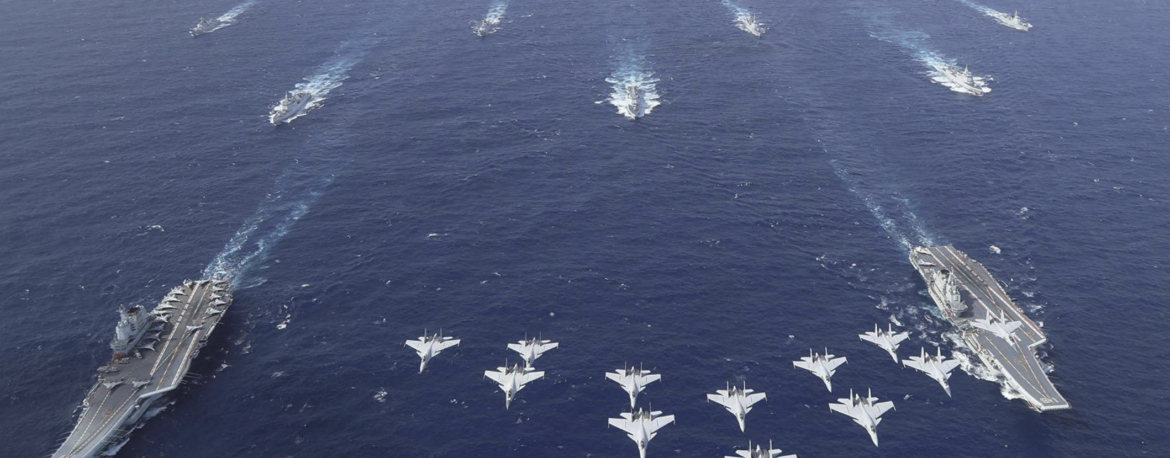
In 2019, China’s strategy changed again for the “new era”; however, this was mostly just a rebranding of the earlier 2014 changes. This rebranding is important nonetheless, as it came just after Xi’s government centralization efforts in 2018. Thus, despite the minor changes between the 2014 plan and the 2019 one, the newly streamlined leadership gives this era a different feel. Under Xi, China has continued to push towards modernization and intends to expand its military capabilities. Steering away from the A2/AD doctrine, China has built 3 aircraft carriers and has a 4th nuclear-powered carrier under construction. Aircraft carriers are nearly exclusively offensive weapons, not designed to deny access or area control but rather to expand reach. Thus, such an increase in carriers demonstrates a nonverbal change in the priorities of the PLA. In total, China intends to have 6 more aircraft carriers at sea by 2035, expanding its military reach beyond the A2/AD defensive bubble. China, despite slow progress, has also continued to push forward with building up blue-water capabilities in its fleets. Such blue-water capabilities further demonstrate how China is preparing its military to go beyond its A2/AD defensive bubble.
China’s military also continues to expand other non-naval-based offensive weapons. They have built up their air force, introducing new drones as well as new fifth-generation fighter jets. The 2014 plans to increase joint maneuvers allow the PLA to hone its ability to work with neighbors such as Pakistan and Russia. These military changes may be slow-moving, but they have been going on for a while now, turning the Chinese military into a regional military giant.
Beyond the 2014 military changes, the international order has shifted greatly, forcing China to reevaluate its efforts. In the wake of Russia’s war in Ukraine, China has seen that mere military superiority cannot necessarily guarantee expansionist dreams. Despite its larger armed forces, China must consider the lessons from Russia when pursuing its more expansionist goals. China also employs different tactics than Russia, using “salami slicing.” Through this tactic, China has been able to cut off and claim small sections of territory a bit at a time. The Iran war has also further demonstrated for China the dangers of overextending military reach. Thus, China has continued its focus on regional territories, and rather than threatening the whole world with its increasing military strength, China only bothers its neighbors. Furthermore, the Iran war showed China just how powerful non-direct measures could be against the US, such as economic pressure, cyber-attacks, and small targeted strikes.
These shifts in China’s military strategy and arms build-up would be important internationally at any time, but under the new Trump era of international politics, these changes take on a different tone. China’s newer, more advanced naval fleet and improved offensive capabilities, along with its more outward-looking expansionist strategy, pose a large risk to the region. Taiwan continues to be a key issue in this story. Trump’s continued pullback from US allies and focus on his own military agenda in Iran has left Taiwan vulnerable.
Beyond Taiwan, other US allies, including the Philippines, Japan, and South Korea, have been left scrambling to fill the gaps in their national defense left by the uncertainty of the Trump-led US. The Philippines, after tense negotiations, managed to get Trump to honor the previous US pledge of $500 million dollars in military aid. Japan, on the other hand, elected to protect itself amid US pullback, ramping up its own defense spending. Trump has also reduced military drills in South Korea, calling them a waste of money. This sets a dangerous precedent and leaves the US’s long-term ally underprepared for a future North Korean attack. Such an attack could be supported by China as well, given that North Korea is China’s only military ally.
All this combines to paint a picture of a militarily advancing China, compared with an isolationist, unpredictable America. The shifts in China’s military strategy and the build-up of arms continue to signal China’s more hostile expansionist goals under Xi. Under another president, these goals may have been stifled. However, under the Trump administration, these shifts in China are more dangerous than ever as Beijing faces little pushback.
Ultimately, as of today, China’s military continues to lag behind the US in many ways, and it will take quite a while before it poses a large-scale global challenge to the US. This article does not argue that China’s military is an active global threat intent on world domination right now. Rather, I argue that the current changes in Chinese strategy away from A2/AD and the PLA modernization demonstrate China’s continued expansionist aims and a shifting strategy towards offensively capable expansionist global warfare. Such a change may not directly challenge the US or much of the world today. However, it does pose a threat to the rest of Asia and especially to those nations around the South China Sea. Under this second Trump administration, this threat has only become more pressing as the long-standing US military check has been heavily reduced, leaving both Taiwan and the rest of the South China Sea vulnerable. The next two years will show just how far China is willing to expand its control and regional dominance in the wake of this US military vacuum.