By Daniel Braun ’27; Image by VOA News
Over the last few weeks, North Korea has sent approximately 10,000 troops to Russia to train and fight in Ukraine within “the next several weeks,” the Pentagon announced (Cook & Copp, 2024). This addition of fighters is likely “too small a number to affect the overall situation on the broader battlefield, where both sides have deployed hundreds of thousands of soldiers, but potentially enough to help Moscow reclaim its territory in the Kursk region” (Méheut, 2024). A crucial piece of territory not only morally but tactically in the overall conflict. Ukraine is already bracing for this offensive, building up reinforcement in the region. The real puzzle is why North Korea, a fragile and small nation, would get involved in such a volatile conflict that all major powers are engaged to some degree.
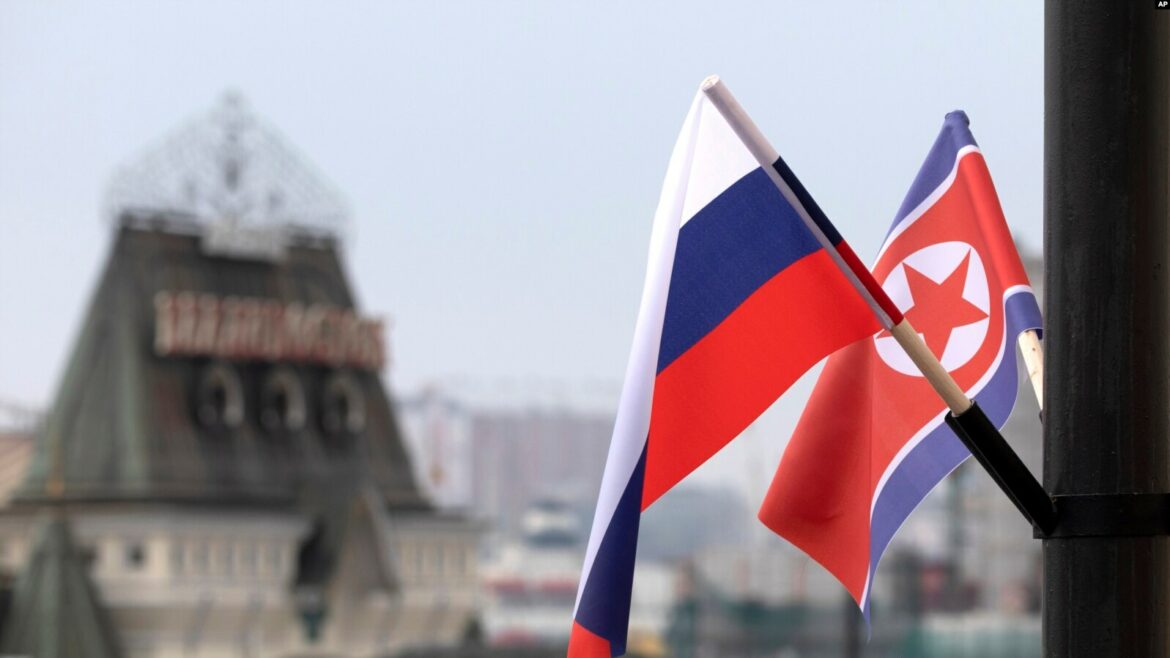
The answer lies in a summit that North Korean leader Kim Jong Un and Russian President Vladimir Putin had in June 2024, where they signed a comprehensive strategic partnership treaty, which includes a mutual defense clause. This agreement commits both nations to provide military assistance to each other in case of aggression. This agreement showed an evolving and stronger political and military alliance between both countries (Drury, 2024).
There are multiple reasons why this treaty is beneficial for both sides. There are indications that North Korea has supplied Russia with artillery ammunition in exchange for food and military aid, suggesting a mutually beneficial arrangement that addresses both nations’ needs. North Korea may be aiming to acquire advanced Russian military technology to enhance and modernize its military hardware and gain insights into sophisticated military strategies.
In addition, this move aligns with North Korea’s stance against Western influence, particularly that of the United States, reinforcing its image as a nation that resists Western imperialism. This aligns with its broader narrative of self-reliance and resistance to external pressures. North Korea has stated that the goal of their alliance with Russia is to create a “multipolar world” where no dominant country can wield hegemonic power”(Drury, 2024).
This addition of troops does not come without a price, though. In North Korea, the leader must deal with the fact that he is sending citizens abroad to fight in a conflict that does not affect them directly. Presumably, and sadly, some of these soldiers will not return home. This means that many in North Korea will be unhappy with this move as their families will be broken apart. To counter this, North Korea will have to convince its population that this conflict connects to the bigger issue of their fight against the United States.
Furthermore, Russia has to supply these troops with equipment and supplies that they do not have in surplus. They also have to work with troops who do not speak the same language, do not know the terrain, and are not heavily invested in the fight. There is already a lack of camaraderie between troops, as reported by CNN: “Russian soldiers have been heard raising concerns about how North Korean soldiers will be commanded and provided with ammunition and military kit, leaked intercepts obtained by the Defense Intelligence of Ukraine and released on Friday show. The Russian soldiers talk disdainfully about the incoming North Korean soldiers, codenamed the “K Battalion,” at one point referring to them as “the f**king Chinese”(Kent, 2024).
North Korea’s decision to send troops to Russia represents a complex, high-stakes maneuver. Despite the limited impact of 10,000 troops on the Ukrainian battlefield, the move symbolizes North Korea’s deepening partnership with Russia, driven by strategic and ideological motives. By supporting Russia, North Korea not only reinforces its resistance to Western influence but also gains access to essential resources like food and potentially advanced military technology. However, this alliance is not without its challenges. Domestically, Kim Jong Un faces the difficulty of justifying foreign involvement to a population with little stake in the conflict, risking both morale and public support. For Russia, logistical issues and cultural divides add further complications.
Bibliography:
1. Cook, L., & Copp, T. (2024, October 28). North Korea has sent about 10,000 troops to Russia to likely fight against Ukraine, the Pentagon says. AP News. https://apnews.com/article/russia-north-korea-nato-ukraine-war-9b7357344d988ea32d8ca 21f6e22dcc5
2. Drury, F. (2024, June 18). North Korea: Pact with North Korea will protect us both from aggression, says Putin. BBC News. https://www.bbc.com/news/live/world-asia-69124350 Kent, V. B., Maria Kostenko, Lauren. (2024, October 25). ‘What the f**k to do with them?’ Russian soldiers heard condemning North Korean recruits in intercepted audio. CNN. https://www.cnn.com/2024/10/25/europe/russian-soldiers-north-korean-recruits-intercepts -intl/index.html
3. Méheut, C. (2024, October 28). Ukraine Braces for Russians to Assault With North Korean Troops. The New York Times. https://www.nytimes.com/2024/10/28/world/europe/ukraine-russia-north-korean-troops.ht ml