By Sasha Wertime ’25; Photo Credit – Global Times
Article 57 of the United Nations’ Conventions on the Law of the Sea states that a nation has claims over 200 nautical miles off the shores of its mainland (United Nations). These zones are called exclusive economic zones (EEZ). “In the exclusive economic zone, the coastal State has sovereign rights for the purpose of exploring and exploiting, conserving and managing the natural resources,” the convention reads. Any area not within the designated EEZs is considered international waters under maritime laws, which means that it is shared amongst all parties and not protected as exclusive to any sovereignty.
The system laid out above is generally accepted by nations that border large bodies of water, and the respect of exclusive economic zones are understood to follow global law. However, the sovereignty disputes of the South China Sea see the PRC contesting what is otherwise generally accepted by the worldwide community to protect what they believe to be their sovereign land.
The South China Sea is incredibly rich in its natural resources: there, you can find 11 billion barrels of oil, 190 trillion cubic feet of natural gas, and 10% of the world’s fisheries (Wolf 2015). 30% of world shipping trade goes through the South China Sea, with it being the route commonly traveled to reach the trading ports of Southeast Asia. Five countries currently lay claim to some portion of the sea: China (PRC), Taiwan (Republic of China/ROC), Brunei, Malaysia, the Philippines, and Vietnam. However, China has argued that they have a historic claim to the South China Sea and its sovereignty; this claim dates back to the 15th century and the naval expeditions of the time (VOX).
The Nine Dash Line and Cabbage Strategy
There are two tactical ways that the PRC has staked its claims to the waters: the building of military bases and man made islands in contested parts of the sea, as well as the drawing of a ‘nine-dash line.’ Militarization and man-made expansion can be seen on three of the sea’s islands – the Spratly Islands, the Paracel Islands, and the Scarborough Shoal (AMTI). The setup of military bases on islands, as well as the use of force to defend those islands, is most salient when discussing the Spratly Islands, which are in the middle of the South China Sea. The Spratly Islands are claimed by China, Vietnam, The Philippines, and Malaysia – this is due to its geographical presence at the heart of the sea. Strategically speaking, several nations would want to claim the Spratly Islands under their jurisdiction because it is in the middle of the South China Sea: referring to article 57, this means that whichever country claims the Spratlys can then extend their EEZs to include all the surrounding islands.
In 1987, China installed a small military structure on Fiery Cross Reef under the pretense of building an ‘oceanic observation station’ and installing a tide gauge for the Global Sea Level Observing System (Chanda 1992). This, arguably, was the catalyst for militaristic expansion on China’s claimant islands. In 2013 to 2015, China further created artificial islands by dredging sand onto reefs which were then made into permanent structures: this was done to strengthen the nation’s territorial claims to the region that fell into the Nine-Dash Line (Wingfield-Hayes 2014). Sam Ellis states for VOX that “by building their own man made islands, China is essentially building naval bases.”
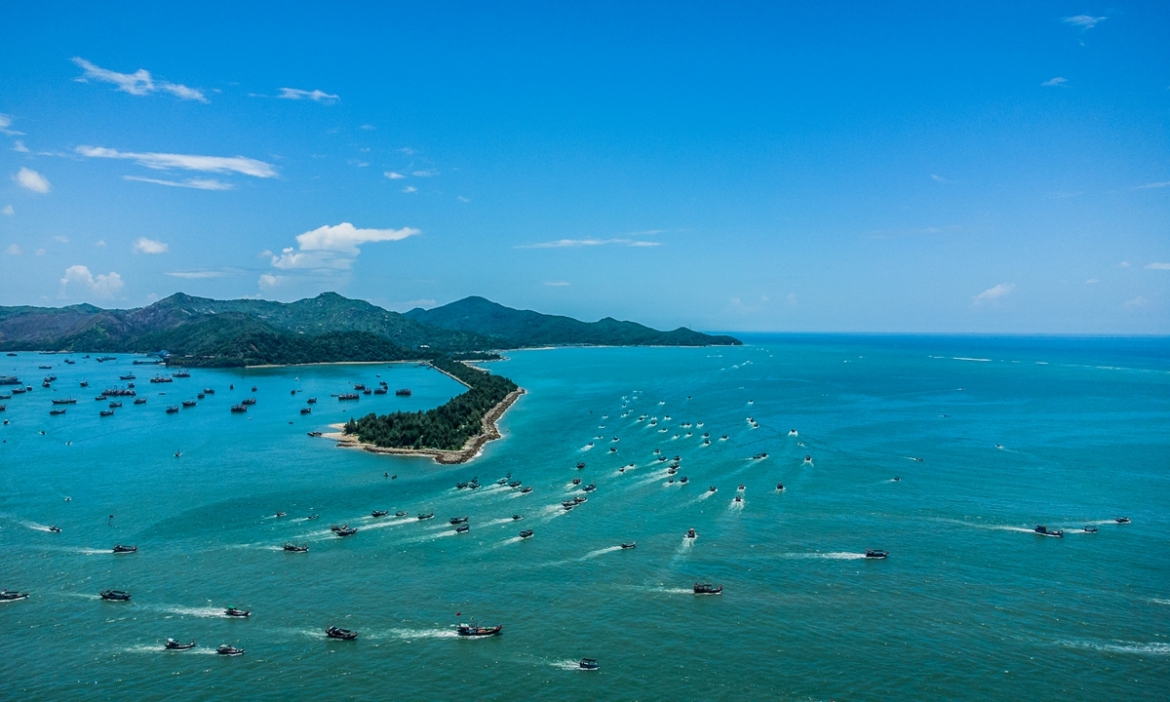
The Nine Dash Line is line segments on various maps that provide ‘evidence’ for China’s territorial claims of the South China Sea’s islands. The line was first inscribed on a Chinese map in 1947 (Beech 2016). In response to the 1973 UN Convention on Maritime Law, China has refused to define its nine-dash line: leading to foreign involvement, and the use of China’s force to protect its sovereignty. An international tribunal in 2016 ruled that there was no legal basis for China’s claim of historic rights and resources that fall within the self-demarcated ‘nine-dash line’ (Pedrozo 2021). Still, to protect the land that China vehemently claims as theirs, they have employed a “Cabbage Strategy”: whereby the PRC’s Navy surrounds a contested island with as many ships as possible. Zhang Zhaozhong, a Chinese military theorist, states that the mechanism of the strategy is to “(wrap) the island layer by layer, like a cabbage” (Himmelman 2013). Since this tactic has been given a name, it is recorded to have been used at least four times by China (AMTI). China’s strategy in the South China Sea involves a combination of military, economic, and legal communicative tactics to assert control over disputed territories and project power in the region. Although these actions have not always involved direct military force, they represent a comprehensive approach to advancing China’s interests.
A Diplomacy of Anger
In a piece from 2011, Todd Hall argues that China’s tactics in international relations resembles a “diplomacy of anger.” This involves a vehement and overt state display of anger in response to a perceived violation. This form of diplomacy contributes to a framing device whereby a certain issue is constructed as being ‘sensitive and volatile’: by extension, it is outside the realm of standard bargaining interactions. Importantly, there is an interplay of hard signals and a coercive application of force, which has characterized Chinese diplomacy in the past century. Hall places his theorized “diplomacy of anger” in binary opposition to the standard International Relations theory used to understand the China issue, as well as increasingly prevalent folk theories – drawing from the IR school of constructivism.
The folk approach that Hall writes about to frame the “diplomacy of anger” resembles what scholars of international relations call constructivism. This refers to approaching diplomacy through a states’ social construction when attempting to understand the interactions between sovereign states. What Hall refers to as ‘folk theory’ is the construction of state actions through emotional, human reactions. In Wendt’s (2004) piece about the personalization of states in international relations, he argues that – in academic discourse – we refer to states “as if they have emotions and are therefore conscious. States are characterized as ‘angry, greedy, guilty, or humiliated’” (313). But, as Janice Stein (2011) further argues to develop Wendt’s argument, “(constructivism / folk theories) are a difficult argument, because it attributes to the collective what is an embodied, individual experience” (24). Constructivism is one lens through which we can understand China’s historic use of force – as well as predict its future use.
Groffman’s theoretical framework – further developed by Robert Jervis – argues that “impression management” is about the image a state is projecting onto the international stage, which becomes an important instrument of statecraft. It is essential to recognize here the disjunction between emotions as a source of policy-making motivation and the state-level decision to make the explicit expression of emotion part of a foreign policy strategy (Hall 2011, 10). However, to get a full picture of China’s historic use of force – and to best be able to predict its use in the future – the state-level expression of anger translates to more aggressive policy making. As Hall puts it, anger can lead to an increase in so-called “expressive gestures”: concrete acts meant to demonstrate anger through shows of force or harming the target’s interests. Now that the sovereignty disputes at the South China Sea have been examined, we can look to two factors that have historically determined if China will use force or not: crisis and surprise.
Weaponizing Crisis
Weiji, the Chinese word for crisis, is composed of two characters that can be translated directly into ‘danger’ and ‘opportunity’, respectively. Because of the latter character – opportunity – the word ‘crisis’ does not necessarily translate into a negative meaning (Shulsky & Burles 2018, 16). The opportunity present in a crisis can thus be making gains that otherwise would not be achievable absent a crisis, showing the essential role timing plays in how the PRC responds to a crisis. Crisis allows for two important outcomes: one that is domestic and another that is international. Creating a crisis can help consolidate domestic political standing and further mobilize a population in support of a regime’s goals. Being able to successfully mobilize the internal population is important: it is easiest to do this during times of crisis.
Aside from domestic political reasons, the Chinese government has initiated crises to probe the reactions of adversaries, as well as to further impress political and militaristic costs of pursuing a policy hostile to China’s interests. Shulsky & Burles (2000) argues that the view that crises are bad – that they offer danger, not opportunity – is the perspective of a status quo power. As China has increasingly ascended to power, the status quo power of the United States has had a noticeably different approach to force. The creation of a crisis is understood to be of less fear to China than a status quo power. Looking at the South China Sea case study, despite international pressure to acquiesce, China has been vehement in defending the nine-dash line. Alongside the role of crisis, surprise is an important aspect in determining if China will deploy force or not.
Employing Surprise
Historically, China has successfully deployed surprise in its use of force. It is important to stress that the key point is not a subjective sense of surprise experienced by the attack’s targets, but whether they had made adequate preparations for it. This can be seen in China’s handling of the South China Sea, as well as its rapid military modernization which has made other countries readjust to an ever-changing status quo. Regarding the South China Sea, China has used increasingly surprising maneuvers to assert its territorial claims in the region. This includes the sudden construction of artificial islands equipped with military facilities – surprising other countries with the boldness of their actions (AMTI). Looking at the rapid modernization of their military, the PRC has rapidly advanced its military capabilities, including the development of advanced weapons systems such as hypersonic missiles and aircraft carriers (Boyd 2023). These rapid modernizations have changed the balance of power in the Asia-Pacific region and the international sphere.
Further, Shulsky & Burles argues that China has previously used force “even when the overall military balance is very unfavorable to them” (11), which comes as a surprise to the adversary. Their analysis of historical records shows a pattern of Chinese use of force in conflicts to achieve surprise, which in turn administer a strong psychological or political shock to the adversary. In looking at how we can predict China’s use of force, the role of surprise in their diplomacy makes it difficult to predict if their use of force will increase or decline. However, regarding the sovereignty of the South China Sea, we see increasingly surprising actions (such as the creation of man-made islands, ten years ago) that seek to expand Chinese sovereignty. With the expansion of sovereignty comes increased pressure to protect it; this then leads to greater force. Additionally, with China’s rapid rise in the global order – thanks in large to the nation’s economic prowess and technological advancements – we can predict a greater orchestration of crises that allow the use of force. This can be done to heed off adversaries who seek to encroach Chinese sovereignty, as well as project an image of aggression to the global order.
With the nation’s rapid ascent to power, it is essential to understand how that power is deployed. Through looking at the salient case study of the South China Sea, we see that China is not afraid to deploy force to assert its own perceived sovereignty. Looking at dominant theories of international relations helps IR scholars understand the adaptive nature of Chinese force. Liberalism ascribes value to the coercive nature of force. Constructivism argues that a state’s image and its management (in the case of China, an image of anger) is the most important. Finally, we can look to the external factors of the crisis and surprise to see how China has used both to deploy force in the past.
This article has highlighted China’s deployment of force, using it to construct arguments that predict China’s future use of force. Particularly, with sovereignty disputes like the South China Sea, force will play an important role in dictating global winners and losers. Ultimately, it can safely be predicted that China will continue to deploy force to protect its sovereignty: at whatever means necessary.
WORKS CITED
Beech, Hannah. “South China Sea: Key Ruling against China’s Claims.” Time, Time, 12 July 2016.
Boyd, Ian. “Here’s What Makes China’s New Hypersonic Missiles Such …” Fast Company, 2023.
Burles, Mark, and Abram N. Shulsky. Patterns in China’s Use of Force Evidence from History and Doctrinal Writings. Rand, 2000.
Chanda, Nayan. “Treacherous Shoals.” Far Eastern Economic Review, vol. 26, no. 2, 13 Aug. 1992, pp. 14–17.
“China Tracker.” Asia Maritime Transparency Initiative (AMTI), amti.csis.org/island-tracker/china/. Accessed 4 Mar. 2024.
Hall, Todd H. “We will not swallow this bitter fruit: Theorizing a diplomacy of anger.” Security Studies, vol. 20, no. 4, Oct. 2011, pp. 521–555.
Himmelman, Jeff. “A Game of Shark and Minnow.” The New York Times, The New York Times, 24 Oct. 2013.
“Overview – Convention & Related Agreements.” United Nations, United Nations.
Pedrozo, Raul “Pete.” “China Again Uses Force to Bully Its Neighbors.” Default, 10 Dec. 2021.
Stein, Janice Gross. “Psychological explanations of international decision-making and collective behavior.” Handbook of International Relations, 2013, pp. 195–219, https://doi.org/10.4135/9781446247587.n8.
VOX. “Why China Is Building Islands in the South China Sea.” YouTube, YouTube, 17 Feb. 2017.
Wendt, Alexander. “The state as person in international theory.” Review of International Studies, vol. 30, no. 2, 17 Mar. 2004, pp. 289–316.
Wingfield-Hayes, Rupert. “China’s Island Factory.” BBC News, BBC, 2014.