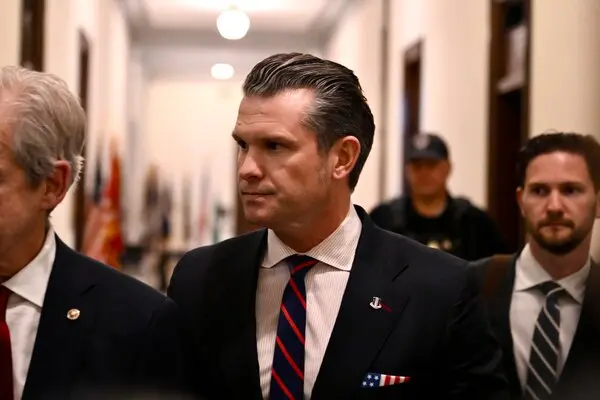
By Rachael Finke BMC ’26; Image by New York Times.
In the weeks following the 2024 presidential election, as each day brought news of another cabinet nomination by the incoming Trump administration, there was not much time to fully understand the implications of each name the president-elect dropped before the headlines were overtaken by the next shocking pic. A few especially outlandish characters and stories dominated the consciousness of Americans who pay attention to politics: Matt Gaetz’s withdrawal from consideration for the Attorney General position; the nomination of Putin- and Assad-apologist Tulsi Gabbard to be the next Director of National Intelligence; and, particularly noteworthy for our Bi-College community, the choice of Howard Lutnick to be the next Secretary of Commerce.
Fox News host Pete Hegseth, Trump’s nominee to lead the Department of Defense, has featured especially frequently in the news, with a particularly dramatic moment being his mother’s appearance on Fox & Friends on December 4th. After the New York Times publicized an email she had written to her son in 2018 in which she accused him of mistreating women, Penelope Hegseth went public as her son’s nomination seemed to be in jeopardy, attempting to convince the senators responsible for his confirmation that he had changed.
With all of the noise about Hegseth, his views, his past, and his qualifications (or lack thereof) for the position of Secretary of Defense, one especially important story seems to have slipped through the cracks. Back in mid-November, a 2018 video resurfaced in which Hegseth, speaking to an audience at the Arutz Sheva conference in Jerusalem, expressed his optimism that through a “miracle,” a new Jewish temple could feasibly be built on the Temple Mount. He continues, instructing his audience to “take your action” and “do what needs to be done here in Israel,” expressing his confidence that the American administration would be supportive of Israeli efforts to assert Jewish sovereignty over the West Bank and rebuild the temple.
Controversy over the Temple Mount is not new; the hill in Jerusalem’s Old City holds significance in Judaism, Christianity, and Islam, being the site of the First and Second Temples (the center of Jewish worship until the Second Temple’s destruction in 70 C.E.) and the Dome of the Rock and Al-Aqsa Mosque. Although the site has repeatedly changed hands, as of now, it is officially reserved for Muslim prayer and off-limits for Jews outside of time slots meant for visiting only (and not praying). However, some extremist members of the religious Right in Israel have attempted to challenge this status quo. Just a few weeks ago, Itamar Ben-Gvir, Israel’s Minister of National Security and leader of the far-right Jewish Power party, said that he had prayed on the Tempe Mount, immediately provoking responses and condemnation from many parts of the political spectrum. This is part of a larger pattern of provocative and inciting behavior on the part of Ben-Gvir, a supporter of a complete Israeli annexation of the West Bank who has a history of celebrating violence against both Palestinians and Jews (including assassinated Prime Minister Yitzhak Rabin) who he sees as getting in the way of the religious Right’s political aims.
Pete Hegseth’s approach to Middle Eastern politics, including both his policy preferences and the rhetoric he uses when articulating them, does not seem particularly distinct from Ben-Gvir’s. Hegseth has a tendency to glorify violence in the name of religion. His primary interest is the Crusades—he wrote a book entitled American Crusade: Our Fight to Stay Free, in which he instructs his fellow Christians that “Voting is a weapon, but it’s not enough” to fight Islamism and leftism and to protect “human freedom,” and that “Our American Crusade is not about literal swords, and our fight is not with guns. Yet.”
Allowing extremist members of a government to treat a religious objective as a priority superseding the rule of law, democracy, and human rights and justifying violence against one’s opponents has, in Israel’s case, resulted in a decline in the state’s legitimacy and a dramatic destabilization of its democracy. The U.S. senators responsible for confirming Hegseth to the cabinet should carefully consider whether this is a risk that they are willing to take in their own country.