By: Shae Mercer, Haverford ’27; photo by Francis Chung/EPA-EFE
The 2026 World Cup, set to kick off in mere months, is currently making headlines. But the stories being reported on don’t concern the football set to be played- instead reporting on the Cup has heavily focused on a variety of ways that the U.S. President Donald Trump is shaping and threatening the tournament and its traditions. An overview of the chaos that Trump has brought to the tournament, along with the ways in which FIFA is permitting, if not supporting, such behaviour raises the question of why? Why is FIFA not using the significant leveraging power of the economic power house that is the world cup to bend the U.S. to its will- rather than the other way around? And why is FIFA allowing Trump to threaten its long-established global tradition?
ICE’s Threat to the Global Tradition
Perhaps the most significant political current running through the 2026 World Cup, is the threat that the Trump administration’s crackdown on immigration poses to the World aspect of the tournament. Trump’s intensifying anti-immigrant rhetoric, an expanding U.S. Travel Ban list, and the ICE raids sweeping U.S. cities have raised more than a few barriers to the World Cup’s goal of uniting the world through football. Many countries, including Mexico, have expressed fears that their fans are unwelcome in the U.S. because of Trump’s anti-immigrant rhetoric, and fear that fans may fall victim to the ICE raids. Moreover, the U.S.’s list of countries under travel bans prevents fans from banned nations from traveling to the U.S to support their teams. The U.S.’s travel ban list currently includes several nations set to play in the tournament, and bans are expected to increase to 30 countries following the shooting of two National Guard members by an Afghan national the day before Thanksgiving 2025.
The U.S. and FIFA have attempted to soothe these fears, though the results appear lackluster. The Department of State recently announced that ticket holders for the 2026 World Cup would receive priority visa appointments to facilitate international fans’ ability to attend the games. Both Infantino and U.S. leadership have publicly said that fans from all over the world will be welcomed to the U.S. for the games. However, these statements of welcome are dampened by Trump administration comments that ICE raids impacting visiting fans could not be “ruled out,” as the administration’s primary duty is to ensure Americans’ safety. And the executive order banning travel makes exceptions for athletes, support staff, and close family members of the National Teams from banned countries to receive visas from the U.S., though fans from banned nations will still be unable to attend. This has already caused the Iranian Soccer Federation to boycott the 2026 World Cup Draw, with their spokesperson making it clear that “decisions taken unrelated to sport” and are in political protest of the ban.
This, of course, runs antithetically to FIFA and the World Cup’s intent to unite the world through football. It could also have real impacts on the attendance of the tournament, potentially dissuading fans from coming to fill the U.S. stadiums- a phenomenon already seen in the U.S.-hosted 2025 Club World Cup, where many stadiums struggled to reach capacity. While the impact is not yet clear, the economic windfall for FIFA and the U.S. could be substantial if uncertainty continues to surround the safety of visiting fans. Moreover, who knows what the extent of international backlash would be against the US and FIFA if international fans were subjected to ICE detentions while attending the tournament.
It is important to emphasize that while diplomacy to host countries IS part of FIFA’s job in facilitating World Cup operations- pandering to host countries is most definitely not. Previous host countries have presented threats to the World Cup’s global tradition before- but none have been permitted to break the tradition. The 2022 Qatar world cup is a prime example of this. Due to tensions around the Israel-Palestine conflict, Qatar and Israel had severed all ties in 2009- including flights of Israelis into Qatar. However, in honoring the global tradition of the World Cup, Qatar allowed not only for Israelis to attend the games, but temporarily permitted direct flights from Israel into Qatar for the games. If former governments have been coerced to preserve the global tradition of the games- why is FIFA letting Trump openly threaten and limit who can and cannot attend the games? The answer could be hiding in the ‘unique’ relationship between President Donald Trump and FIFA President Giani Infantino- which itself has been receiving a significant amount of media attention.
Presidential Love
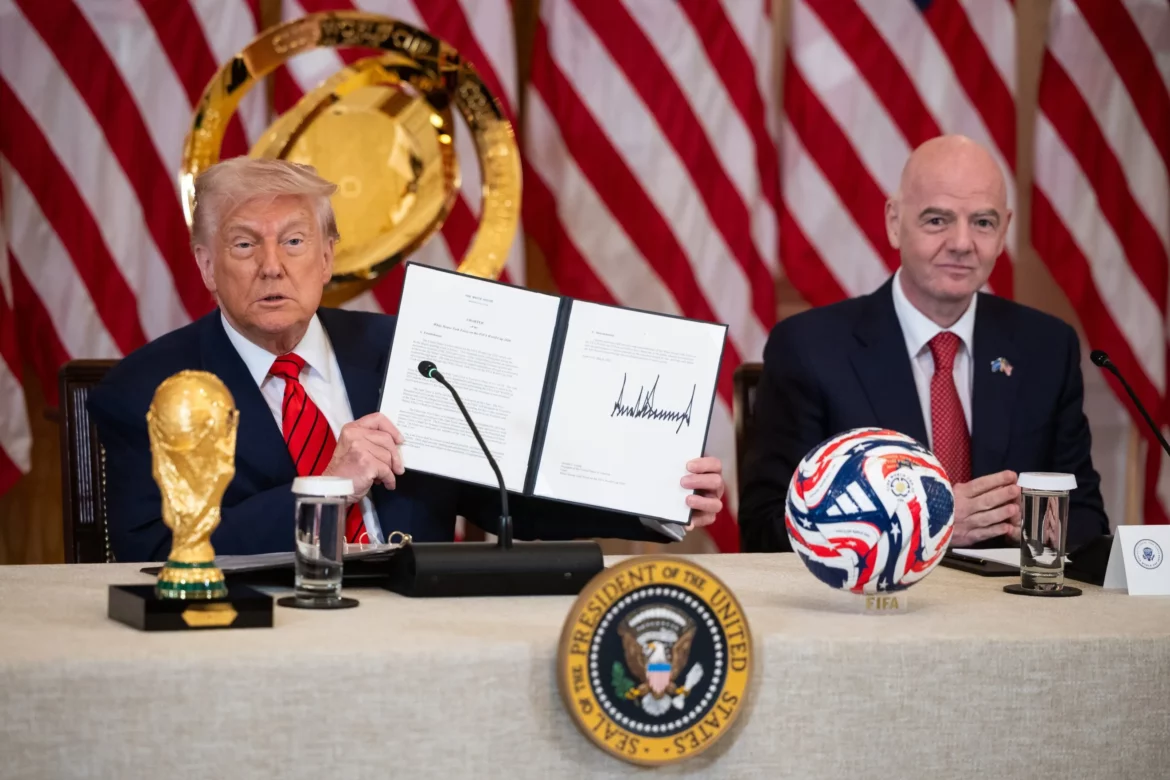
Criticism in the football community has emerged around the ‘overly’ friendly relationship between Trump and Infantino. The two Presidents have developed an increasingly close and public relationship since both Trump and Infantino’s first Presidential terms. Their relationship has featured a variety of public displays of affection, in the form of praise-filled statements, reciprocal gifts, and lavish trips- like any good courtship. Some highlights from their relationship over the years: calling each other “good friends”, Infantino accompanying Trump to the signing of the Abraham Accords, Trump being gifted one of three official replicas of the 2026 World Cup Trophy (a major football faux-pa) and some snuggling up of the two Presidents in a private box at the 2025 Club World Cup Final, that resulted in the decision to host the 2026 World Cup Draw in the Kennedy Center in Washington, D.C.- where Trump is chair.
Recently, one act of affection has been pushed to the forefront of protest against Infantino and Trump’s relationship: the creation of FIFA’s very own “FIFA Peace Prize”, announced on November 5, 2025. FIFA President Gianni Infantino introduced the Prize to the world on Instagram, declaring that the purpose of the prize was to “recognise the outstanding contribution of those who work hard to end conflicts and bring people together in a spirit of peace.” The prize was subsequently awarded to the U.S. President Donald Trump on December 5, 2025 at the 2026 World Cup Draw. The creation and awarding of the prize to Trump has been seen as an act of overt pandering by Infantino to Trump’s desires for global recognition as a steward of peace. This speculation was based on the proximity of the creation of the FIFA prize to Trump’s recent snub from receiving the Nobel Peace Prize on October 10, 2025, which he had openly campaigned for throughout the duration of his second term.
While, realistically, the significance of receiving a peace prize from a football organization is about nil, Infantino and FIFA have faced backlash for this display of support for the ever-polarizing Trump. Criticism has centered on Infantino, particularly, accusing him of violating Article 15 of FIFA’s Code of Ethics, which requires FIFA officials to remain “politically neutral” in “accordance with the principles and objectives of FIFA.” Events under fire for this breach of neutrality include the creation and designation processes of the FIFA Peace Prize and statements of personal support for Trump’s leadership by Infantino, including Infantino’s endorsement of Trump’s leadership as “looking pretty good.”
In response to the FIFA Peace Prize, the British humanitarian non-profit FairSquare has even filed an official complaint against Infantino on the grounds that he has “frequently” violated the FIFA Code of Ethics. The complaint could prompt an investigation into Infantino, and if found guilty, Infantino could be hit with a hefty fine as well as up to a two year ban from “any football-related activity”.
Critics have pointed to Infantino’s and Trump’s friendly relationship as further evidence that Infantino is violating FIFA’s political neutrality clause. Still, Infantino has argued that his relationship with Trump is what is diplomatically necessary to ensure the success of the 2026 Cup. This is despite the fact that Infantino seems to have made few attempts to ingratiate himself with Mexico’s President, Claudia Sheinbaum, or Canada’s Prime Minister, Mark Carney. Infantino’s interaction with the two includes a small smattering of publicly known interactions, and neither of the two leaders has a Peace Prize. Moreover, although President Biden was in office for far more of the 2026 Tournament planning than Trump, Infantino and Biden’s relationship was far more reserved than that between Trump and Infantino.
So, what could be Infantino’s diplomatic reason for ingratiating himself with Trump? It could be because of Trump’s characteristic volatility. Planning for World Cup Tournaments takes years- especially the ambitious 2026 tournament, which will showcase 48 teams in comparison to previous years’ 32 teams, across three host nations instead of one. Moreover, Trump has repeatedly shown the world he is hard to plan for. Regarding the 2026 Cup, Trump has already threatened that he “might ask FIFA to move games from certain cities if he feels crime is too high or local leadership isn’t cooperating with the federal government,” More likely, Trump is seizing the opportunity to wield the economic benefits of being a host city for the World Cup over the heads of city administrations who have agitated against Trump’s leadership. Trump has claimed that Infantino would support these changes, but realistically, the cost of changing which cities host World Cup matches would be huge, not only for cities themselves but for FIFA. Infantino could be trying to mitigate this volatility by keeping the President amicable by showering him with gifts and praise, like any good relationship. Meanwhile, the leadership of Mexico and Canada, viewed as ever peaceful and predictable partners in the Tournament, get neglected by Infantino. Perhaps Infantino truly is acting as the ever-wise diplomat in managing his global relationships.
But there are a few reasons that Trump and Infantino’s relationship doesn’t seem to boil down to simple diplomacy. For one, Infantino has a history of warming up to the most, simply put, autocratic of leadership. In 2019, Infantino received the Russian Order of Friendship Medal from Vladimir Putin, after the two leaders had become close during Russia’s hosting of the 2018 World Cup. When Qatar, host of the 2022 World Cup, came under fire from the global community for immense human rights violations, specifically in relation to migrant labor conditions in building World Cup Stadiums, Infantino passionately defended the nation, its leadership, and its right to host a World Cup.
Infantino’s over-the-top admiration of Trump is also perplexing when considering that it is unnecessary given the power that Infantino and FIFA wield. The 2026 World Cup is projected to create $17.2 Billion in gross domestic product for the U.S.- a deal that a businessman like Trump could surely not pass up. Given this financial power, FIFA can afford to be far more strong-handed in its dealings with Trump, or at least far less pandering. The U.S. benefits from FIFA choosing to host its tournament on American soil- yet Infantino is making it seem like it is FIFA that is indebted to the U.S.
Diplomacy and Distraction
When reviewing the various political debacles circulating around the 2026 World Cup, it strikes me that the one making the most news right now is the FIFA Peace Prize. The attention being paid to an irrelevant, if not poorly ascribed, prize and Infantino and Trump’s relationship is overshadowing the very real threat that U.S. immigration authorities pose to international fans traveling to support their nations in the tournament. The awarding of this prize comes just in time to take the international spotlight off the Trump administration’s threat to the international nature of the tournament. While this may be a clever move by Infantino, if attention is not paid back to this threat, and remedies not found before the Cup kicks off in June, the 2026 World Cup may see the World divided, not united, by football.
Moreover, it is still unclear why FIFA is pandering so heavily to the US’s, and specifically Trump’s, refusal to honor the global traditions of the games. As they stand now, Infantino and FIFA seem to be going out of their way to appease Trump, while disregarding the football community they are supposed to serve. This challenges the precedent set by previous World Cups, in which host countries were forced to capitulate to the global tradition of the World Cup, regardless of their own political conflicts. It also is simply not a necessary pandering- the World Cup brings enough financial power to host countries that Infantino and FIFA could leverage this power to keep Trump in line. But, Infantino and FIFA don’t seem to have made any such coercion attempt, and it remains possible that FIFA will let Trump disparage the Cup’s global tradition.