By Colin Hulett, Haverford ’28; Graphic from Medium
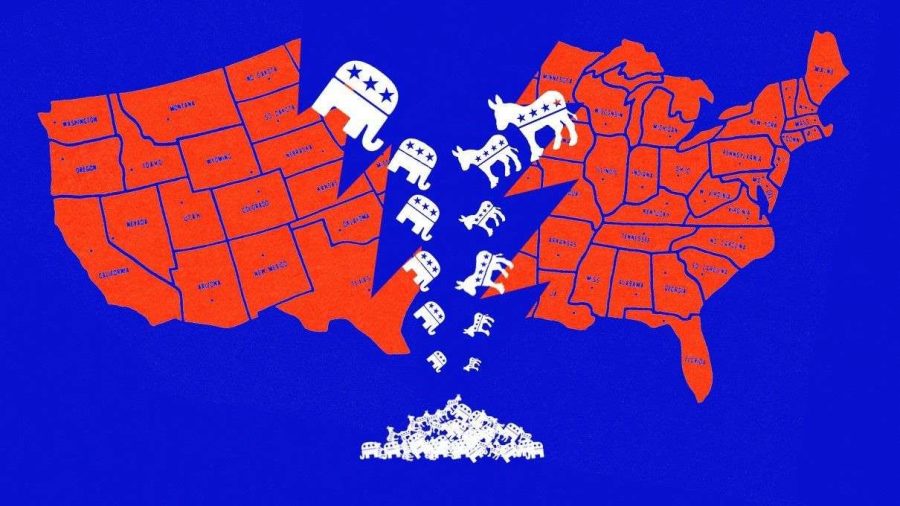
The United States government is plagued by polarization and gridlock, which has caused domestic and international issues. This is exemplified by the 43-day government shutdown, the longest in history, which ended on November 12th, 2025. Even after 43 days, Republicans and Democrats could barely agree, and the cloture vote to end the filibuster narrowly passed 60-40 in the Senate, the minimum number of votes required to invoke cloture and proceed to a vote on the bill. This illustrates the disconnect between the two political parties and their unwillingness to compromise and see each other’s side. This creates domestic issues, such as disruptions and uncertainty in SNAP benefits, furloughs among federal workers, and economic impacts. Government shutdowns stem from political polarization, causing gridlock in which neither party can agree on issues, leaving the government unable to effectively function without funding. The problems caused by political polarization and gridlock are not limited to the United States; they also affect U.S. foreign policy. U.S. foreign policy is undermined by political polarization because it makes it challenging to negotiate and create treaties, advance broader foreign policy goals, and opens the door for other states to exploit policy divisions.
Polarization inhibits the United States’ ability to make treaties with other countries because partisan divisions make it difficult to reach consensus on foreign policy. Under the Constitution, the government relies on Congress to “‘regulate commerce with foreign nations’, ‘declare war’, ‘raise and support armies’, ‘provide and maintain a navy’, and ‘make rules for the government and regulation of the land and naval forces.’” The Constitution also outlines the President’s power: “He shall have Power, by and with the Advice and Consent of the Senate, to make Treaties, provided two-thirds of the Senators present concur.” These provisions of the Constitution outline how the President serves as the lead diplomat but is constrained by Congress, which must approve all treaties and can limit the policy agenda through its enumerated powers. This strong power held by Congress in foreign policy has left it open to disagreement and led to an inability to create legitimate, lasting treaties. Jonathan Masters, writing for the Council on Foreign Relations, explains, “Political hurdles associated with treaties have at times led presidents to forge major multinational accords without Senate consent. For instance, the Paris Agreement on climate change and the Iran nuclear agreement, both negotiated by President Obama, are not treaties.” The division within Congress prevented the United States from developing strong foreign policy programs and led to weaker accords rather than treaties. These are much harder to impose, harder to hold countries accountable, and easier for presidents to withdraw from. Congress’s role in foreign policy has opened it up to polarization, weakening the United States’ ability to create and sustain treaties.
Polarization limits the United States’ ability to advance broader foreign policy goals. History has shown that multinational accords, such as the Paris Agreement on climate change and the Iran nuclear agreement, have eroded because they lack a legislative basis. This follows a broader pattern, as explained by Friedrichs and Tama: “The principal concern of this work is that polarization undermines bipartisan consensus for the grand strategy of liberal internationalism that has guided U.S. foreign policy in the post-World War II era.” This underscores how ‘liberal internationalism’- the promotion of democratic ideals, free markets, and building alliances – has been a staple of U.S. foreign policy, and polarization has begun to erode this emphasis. Therefore, the increase in political polarization in Congress has led to a breakdown of broader foreign policy goals that once received bipartisan support.
The increase in political polarization in the United States has made the U.S. less reliable. In Polarization and US Foreign Policy, Gordon M. Friedrichs and Jordan Tama describe how polarization has affected the reliability of U.S. foreign policy, hindered its ability to improve, and opened up vulnerabilities to foreign actors. Polarization has made the U.S. less reliable to foreign states, as its foreign policy shifts swiftly based on which party is in power. This is exemplified by the shifting use of the Paris Climate Agreement: President Trump withdrew from it, then President Biden reentered it. This illustrates that polarization in the Senate has limited the ratification of accords into treaties, undermining U.S. foreign policy and ultimately making it less reliable.
This unreliability has created vulnerabilities, especially in the United States’ alliances. Carrie A. Lee in Polarization and US Foreign Policy adds that alliances are heavily affected by polarization in the U.S. because allies rely on the U.S. for funding and protection, and an ever-shifting, unreliable attention to these allies offers foreign adversaries an avenue to build greater influence. This threat does not only apply to alliances but also to domestic politics in the United States, where other countries could exploit strong partisan divides. This includes trying to destabilize the U.S. by strengthening the partisan divide, as well as foreign interference operations, such as Russia’s efforts in 2016 and attempted influence activities around the 2020 elections, to increase polarization. Polarization in the United States creates vulnerabilities for American foreign policy and has domestic repercussions.
Political polarization has become pervasive in the United States Government, spurring problems both domestically and internationally. This polarization within Congress has weakened the United States’ international power by preventing the creation of lasting treaties, the pursuit of long-term policy goals, and opening the country to foreign exploitation. Even though some may argue that the President has the ultimate power to decide foreign policy and therefore it is not susceptible to polarization, this is incorrect. For one, Presidents have become increasingly polarized, and the push-and-pull on the foreign policy agenda that occurs with every change in presidency is the result of a sharply divided country. Secondly, Congress’s partisan divisions prevent the creation of treaties necessary for long-term foreign policy. Polarization weakens the United States and poses a risk to national security, and to prevent this, Americans need to return to dialogue and avoid polarization from crippling our constitutional republic.