By: Arman H.; image from NP Review
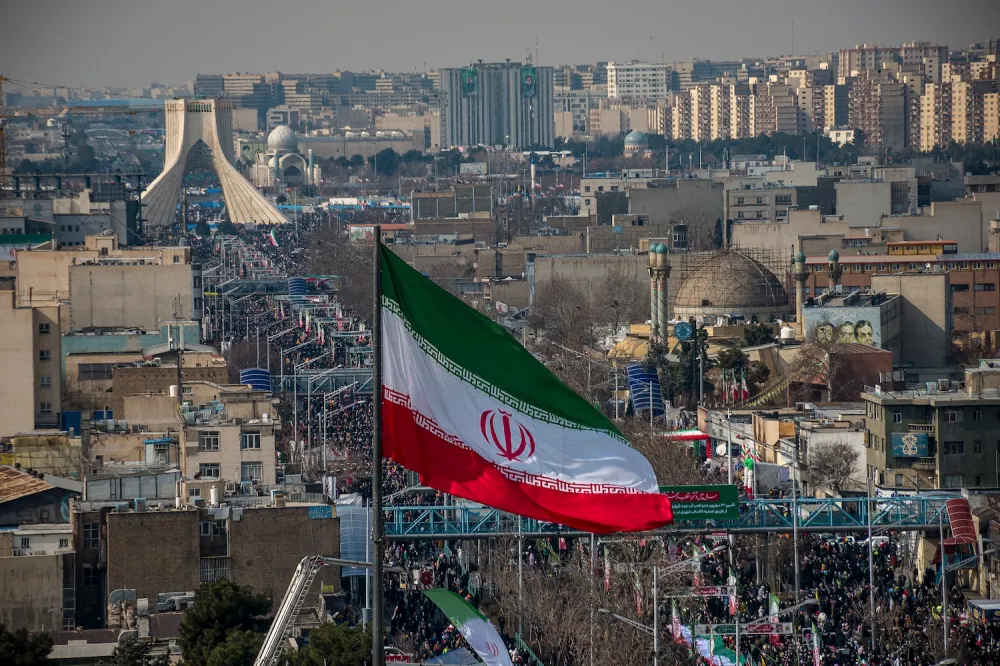
When the June 2025 war between Iran and Israel (also called the “12 Day War”) broke out, both the Iranian government and much of the international media gave descriptions of a nation united under attack. Commentators were speaking of a rally round the flag effect, where ordinary Iranians supposedly put aside their opposition to the regime to back their state. Images of state-backed demonstrations and patriotic messaging on social media seemed to confirm it.
In reality, this image was merely a mirage. The war did not fix deep divisions between Iranians and their government, nor did it produce genuine solidarity. Instead, it only exposed how far the Islamic Republic has drifted from the society it governs. A closer look, especially at postwar public reactions and polling, shows that the brief illusion of unity quickly gave way to anger and irony, while strengthening Iranians’ resolve for political change. The question is not why the rally effect was weak; but why it could never have happened in the first place. The answer begins by the most fundamental: legitimacy.
Legitimacy Crisis
A temporary surge in approval for the incumbent leader or government as a result of direct attack is the typical description of the “rally round the flag effect”. Rallies amplify the legitimacy of a government in moments when the public perceives an external threat. But Iran’s regime is facing such a profound legitimacy crisis that no rally could meaningfully restore support for either the system or for Khamenei himself.
Amidst and immediately after the war, journals and newspapers were writing that the war backfired on Israel because it resulted in a “visible surge in nationalist sentiment”, or that instead of breaking Iran it “helped unite it”. But what does polling suggest? The institute Gamaan has been keeping track of Iranians’ political orientation since 2021, and post-war polling showed no increase in support for the base (stable at 11% since the 2022 protests), or even for reformists (12.5%) who do not believe in regime change. Ironically, it wasn’t support for the government that increased; it was rather support for “regime change as a precondition [for political reform]” that had an uptick from 35% to 41%. This was primarily driven by the drop of support amongst those who either wanted some sort of orderly transition away from the Islamic Republic or had previously expressed no opinion.
This crisis is not abstract. When the government cannot reliably provide water or electricity and citizens experience daily administrative failure, lived experience will always outweigh propaganda. You cannot grow patriotism where no state exists beyond the coercive apparatus. When the base level of support is already weak and nearing single digits, there is simply not much to rally around.
Not a Patriotic War
Rally effects occur when a country faces a direct, outside, and (perceiveably) unprovoked attack that poses a threat to the “homeland”. By contrast, the Iran–Israel conflict involves no dispute over land, borders, or resources. In other words, there is no threat to tangible national interests; the war is purely ideological. The confrontation exists solely because Tehran insists that Israel must be destroyed, and Iranians recognize that it’s unnecessary. In the same poll conducted in September 2025, 70% stressed that the IR must stop calling for the destruction of Israel, and a plurality believed that “The Islamic Republic was responsible for starting the war”. Almost two thirds also believed that the war was between the Islamic Republic and Israel, not Iranians, while only less than a third considered it to be a “patriotic war”. Simultaneously, the top emotion that Iranians reported experiencing was “anger at the Islamic Republic”, which directly contradicts the supposed rally effect.
To put it bluntly, a government that starts a war for ideological reasons cannot reliably count on citizens to share in its sense of mission, especially if it had long disowned the mission to protect and prioritize the nation.
The Islamic Republic Had Long Disowned Nationalism
Rallies require some foundation of shared national mission and identity to build upon; and Iranians no longer share their identity with the government. For decades, the Islamic Republic has distanced itself from Iranian nationalism. Every year, Khamenei’s Persian New Year address is famously void of any Nowruz symbols (the vast majority of Iranian families display a Haft-seen, even the White House has one); his most powerful arm, the IRGC, does not even include “Iran” in its name; and in domestic discourse, the regime almost exclusively refers to itself as the Islamic Republic. Khamenei’s title, Supreme Leader of the Islamic Revolution, reflects the same distance from national identity.
As the government has distanced itself from the Iranian nation (and instead closer to the Muslim Ummah; see the “Umm al-Qura” theory), Iranians have similarly distanced themselves from the regime. Polling again underscores this divide: fewer than a third of Iranians now religiously identify as Shia Muslims, while secular, liberal and nationalist orientations dominate their identity. Opposition to the regime is thus no longer merely policy-based, but rather based in identity itself.
This is not to say the government did not attempt to invoke nationalist sentiment, as it did during the Iran-Iraq war, but that the attempt failed and was seen as disingenuous and inauthentic by the public. On social media, Iranians coined a tongue-in-cheek term “12 Day Patriots” to mock those who were suddenly claiming to love their nation during the war. This captured the public’s skepticism perfectly: after decades of erasing national symbolism, the regime could not credibly resurrect it overnight without appearing opportunistic. The government was slow to realize this fact, and they went as far as installing a statue of the Persian emperor Shapur I capturing the Roman emperor Valerian in Tehran. The attempt was widely mocked across social media as desperate, and they quietly removed the statue in December.
Media Mistaking Silence for Consent
So what exactly explains the widespread perception of a rally effect in these reports? Much of it stems from how information was gathered and reported.
Many journalists rushed to publish “firsthand accounts” of “everyday Iranians” and “opposition activists” showing unity or opposing the war, while overlooking the heavy suppression and surveillance imposed by the state during the conflict. Authorities warned that in these precarious circumstances, any expression of sympathy for Israel or support of the war would constitute treason, punishable by death.
On this basis, the government launched a new wave of arbitrary executions targeting those accused of espionage or dissent. Exact public figures are not available, but according to the State Department, Iran executed 260 people in November 2025 alone, while averaging four executions per day this year, according to Amnesty.
In an environment where fear and repression silences dissent, visible “support” cannot and must not be taken at face value. Reporters and analysts who repeated Tehran’s narrative of “national unity” failed the even basic principles of reporting in authoritarian environments, that is when dissent carries the threat of prison or execution, silence does not automatically mean consent. If anything, it reveals more about the opaqueness of information in authoritarian contexts than about public opinion. By amplifying the regime’s fabricated echo chamber, they inadvertently legitimized state propaganda on a global stage and helped in obscuring reality; a reality of fear, suppression, and national detachment rather than the click-worthy patriotic fervor.
What the 12 Day War revealed was how few still believe that the state flag represents them. The regime’s legitimacy crisis, ideological approach to war, its estrangement from Iranian national identity; they all made a genuine rally impossible. What the press reported as patriotic revival was, in fact, the regime talking to itself, and it was echoed abroad by those who mistook silence for consent.
Patriotism, it turns out, cannot be manufactured in 12 Days.