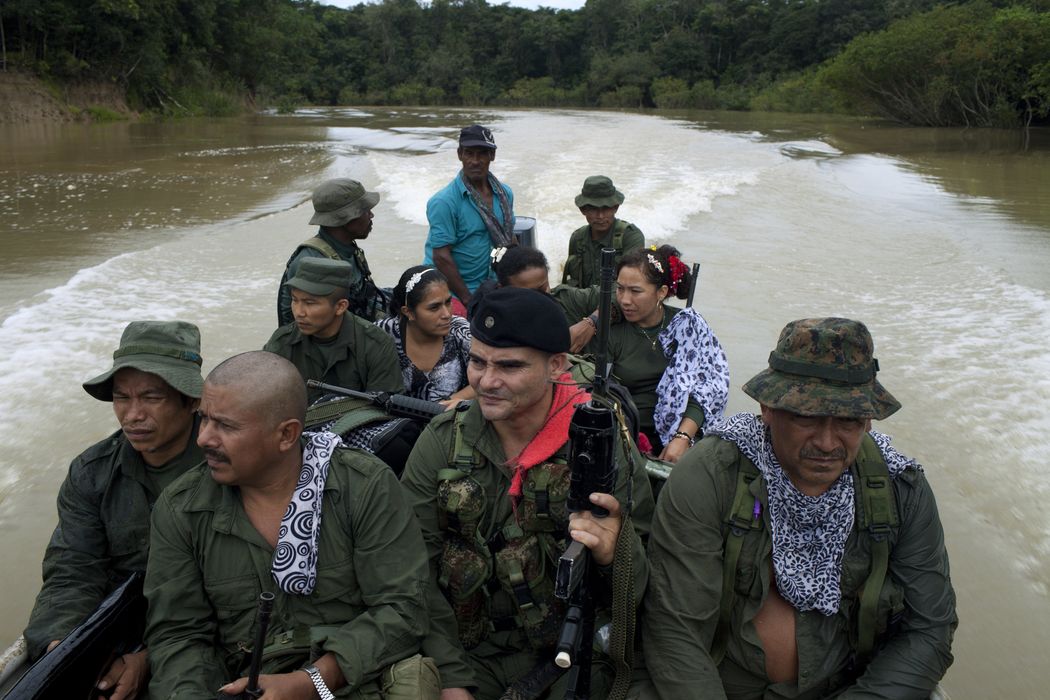
By Alexa Horkava '22; Photo of FARC Guerillas in Colombia in 2016 from the Wall Street Journal
In the rural areas of Venezuela’s department, Apure, life looks very different compared to the country’s inland. In the mornings, young children can be seen walking towards the local coca fields rather than to school in order to feed their families. In the evenings, the department’s villages turn into ghost towns due to the strict curfews and movement controls imposed by the new local elites; former Colombian guerrillas that solicit their cocaine trade through remote and stateless territories at the border between Colombia and Venezuela.
Peace Deal Broken
In 2016, a peace deal signed by the Colombian government and the Revolutionary Armed Forces of Colombia (FARC) officially ended the country’s longest internal armed conflict. In exchange for the forces’ demobilization, the peace accords guaranteed protection and reintegration of former guerrillas into the society. However, despite commitments on both sides of the conflict, much of the peace deal remains unfulfilled; despite the demobilization of more than 13,000 guerrilla fighters, more than 5,000 still remain active. Similarly, despite the governments’ safety guarantees for demobilized rebels, rumours about unsanctioned killings undertaken by the country’s military and other rebel groups have been resurfacing. As such, many former guerrillas fled Colombia and took refuge in Venezuela, whose government has been openly welcoming towards them for decades.
Venezuela’s Alliance with the Rebels
Although the peace deal and its subsequent lack of implementation led to a significant increase in guerrilla fighters and groups operating on the Venezuelan territory, Colombian rebels have been present in the border departments through which they smuggled cocaine since at least 1980. Encouraged by the friendly rhetorics of the Chavez and Maduro-led governments, the representatives of FARC and ELN (National Liberation Army), the second biggest guerrilla group in Colombia’s conflict, have established operations which involve collection of the coca leaves, production of cocaine and its export to the United States and Europe, for which they began soliciting the local populations. Due to economic and security hardships in both Colombia and Venezuela, many residents of the border regions have complied, including children, thus allowing the guerrillas to take control over strategically advantageous territories.
Instead of suppressing the drug trafficking, the Chavez and Maduro regimes have allied with the guerrilla groups and ensured their safe passage in exchange for profits from the trade. Additionally, they have also been accused of coordinating with the active FARC and ELN guerrillas when purchasing weapons and training them to use them. Yet as the guerrilla groups splintered into factions and began competing for control of the established trafficking routes, the alliances broke down and the Venezuelan army launched an air offensive against the competing rebel factions, likely aiming to combat the competing factions and reestablish control over the region and the trafficking business.
The Role of Cocaine
Whereas the alliance between Venezuela and FARC/ELN might have begun due to the shared marxist ideology, the geopolitical and economic interests of both sides led to its expansion to what many call Maduro’s criminal syndicate. Geopolitically, Venezuela has long since attempted to destabilize the US-backed Colombia, its regional and ideological rival, by collaborating with the rebel groups aiming to overthrow the country’s capitalist government. Economically, the profits from drug trafficking have fuelled the operations of Venezuela’s organized crime groups and ended in personal pockets of the country’s elites, such as the cabinet members, army generals and Maduro himself.
The lucrativity of cocaine trafficking has since the 1980s ensured mutual cooperation at all stages of its production and export. The lack of state control over remote territories of Colombia and Venezuela, and the associated poverty, scarcity of formal employment and protection from the state security apparatus among rural citizens, assure their participation in coca plant cultivation and the making of coca paste, a second step in cocaine production, in exchange for a payment. Low salaries and a distinct lack of oversight secure the collaboration of the state security forces tasked with preventing cocaine exportation and catching the narcotraffickers in exchange for a continuous bribe. Corruption among the state elites guarantees the absence of accountability mechanisms associated with the cocaine trade. Until recently, as long as the guerrilla groups ensured that someone at all stages of cocaine trafficking gained economically, their business model prevailed.
Where to Next?
The disintegration of FARC into smaller factions, the resurfacing of ELN and their fight for control of the trafficking routes however resulted in a sharp increase in violence at the border between Colombia and Venezuela. In response, many civilians have been displaced from their homes, adding to the refugee crisis occurring in the region since Venezuela’s economic collapse. As the violence escalates, also upon the involvement of the Venezuelan government in the conflict, the drug trafficking routes become more crowded and dangerous, and the region more destabilized. The outcome of the conflict will depend on the Maduro government’s ability to ally with the winning rebel faction or on its ability to take sole control of the trafficking routes, which is however considered to be highly unlikely. Only one result is certain – without foreign involvement of powers such as the United States, narcotrafficking will continue even amidst the increased violence, and potentially without the blessing of the Venezuelan regime.